October 2013. Java, Indonesia
Mount Merapi, at 2,930 metres, is one of Indonesia’s most active volcanoes, which is no mean feat in a volcano-ridden country like Indonesia. We signed up for a ‘sunrise trek’ to the top without thinking too deeply about what that logistically meant, and the 9 hour experience that followed will remain one of my top examples of Type 2 fun.
Once again – only one of these is my writing, the other is a creation of AI – enjoy!
Essay A
At 12.45 am, vaguely annoyed about being up at this outrageous hour, we started our trek on a tar road that seemed to endlessly extend into the darkness at a steady incline of 45°. High on the enthusiasm of climbing a volcano, I took off at a determined and crisp pace. Eventually, I found my pace dropping as my breathing got harder. Soon, my thighs were screaming for a rest. I stopped, and checked the time.
It had been ten minutes. Just 4 hours and 20 minutes more of this left to get to the top then.
Soon we got off the road and onto the mountain slopes, and my whole world was narrowed down to the tiny circle of light from my dim torch. There was a fine silt covering the mountain slopes that made the climb slippery, and as a bonus, crept in everywhere. And I mean EVERYWHERE – nose, mouth, clothes, bag, food, drink, hair – nothing was left untouched once the dust rose in indignant plumes from our clumsy struggles to climb up. With every step, we held on with all four limbs, desperately trying to avoid crashing bum first into the person behind. I have never loved tree roots more than when they sprouted up unexpectedly to give us a hand in particularly slippery bits.
After seeming endless hours in the dark, we started to slowly cross the major milestones on the mountain – halfway point, plateau 1, plateau 2. Our very sweet trek guides, having seen enough of our fitness levels by this point, suggested in broken English that while “normal” people could get to the summit in 4 hours, we would probably miss the sunrise if we tried, and that the views from plateau 3 were really quite *thumbs up*.
The first painting-like glimmers of faint yellow started to appear in the east, promptly making us forget our screaming quads and frozen fingers. We were now in a race against the very rotation of the earth, competing to reach plateau 3 before the sun peeked out, until…
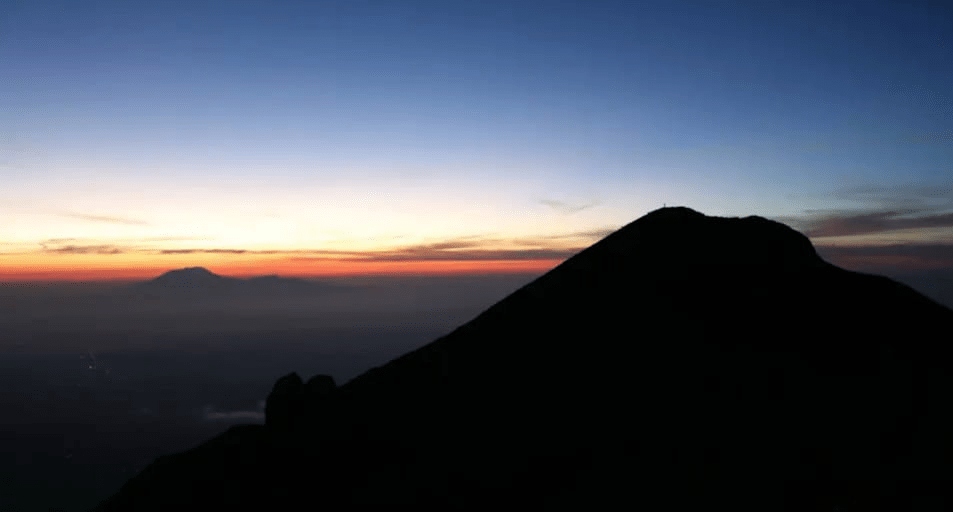
Sunrise at Plateau 3!
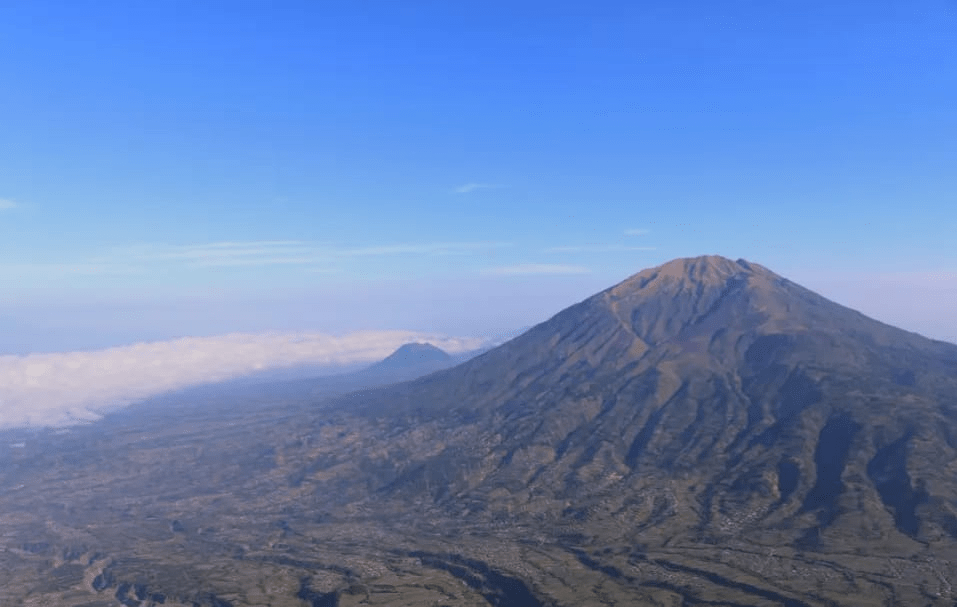
Breathlessly, I turned in a slow circle staring at the jaw dropping panorama that had been silently waiting for us in the dark all along – the hulking mass of Mount Merbabu (Merapi’s sister volcano) to the north, the low hanging clouds in the valley to the west, Mount Merapi’s own surreal volcanic summit to the south, all rounded off by the stunning sunrise-in-progress to the east.
Once we picked up our jaws off the floor, we proceeded to do a photoshoot of a pre-Instagram era – no thought given to composition or captions or filter – just several frozen fingers trying their best to capture the majesty their eyes were witnessing.
After a gentle nudge from our guides and high on the adrenaline of the incredible views we had just witnessed, we started back down the mountain exuberantly – even the silt felt like a dear friend by now, having found permanent residence in our shoes, bags, hair and fingernails. But adrenaline only lasts about an hour, and we still had 4 more to go. The good news now was sunlight, so we didn’t have to scramble in the torch-lit darkness. The bad news was also sunlight, beating down our necks and creating beads of sweat that went to party with the silt collecting in various crevices of our bodies. The mountain slowly leeched all the motivation to go down faster, other than a desire to wash the mud off, which wasn’t strong enough to prevent thoughts of “I could probably just live here for the rest of my life, it wouldn’t be that terrible” each time we found ourselves in the dust again.
When I finally stumbled into the drinks stall right at the base of the mountain like a deranged dehydrated maniac, a word-for-word transcript of my brain at that point would have probably read:
“Water..? Cold..? No cold..? Pocari? Point. Ice? Yes! Food..? Banana! How much? Pay. Sit.”
*slump onto stool*
After a 300ml sized gulp of Pocari, my brain regained function, and a banana later, I was human again. That stall did brilliant business that morning as drinks and bananas got bought for all the others in my group as they straggled in and slumped onto more stools. A debrief revealed a swollen knee, a possibly sprained ankle, a thorn filled hand, some suspicious calf pains and without exception, a silt colored coating on everyone and everything.
As I typed this the next morning, my thighs screaming at every step and forearms questioning why I refuse to just lie still, I can easily say that memories of Merapi will still be rattling around in my head in my death bed. Will I ever go again? Probably not, but would I tell others to try it? Definitely – it’s an experience to be had at least once in a lifetime!
Essay B
I stood at the trailhead, tightening laces on boots that felt far too flimsy for the vertical world above. I had agreed to this “classic midnight trek” over a casual dinner, convinced I’d be back for breakfast. I didn’t realize then that “grit” on Merapi meant literally inhaling the mountain one centimeter at a time.
The first hour was a lie. The trail began as paved paths through tobacco fields. My breathing was rhythmic, my ponytail swung with confidence, and I felt like a rugged explorer. I even took a smug selfie with the flickering village lights below. “This is great,” I thought, the adrenaline masking the burn in my quads. “I should do this more often.”
The “ash” arrived as we cleared the tree line. The path became a forty-five-degree slope of loose scree. To move upward, I took two steps forward and slid one back. Every movement sent a cloud of volcanic dust into the air, coating my skin in a grey film. My lungs felt like they were being scraped with sandpaper as I struggled against the thin, sulfur-tinged air. Merapi was no longer a scenic landmark; it was a crumbling, infinite mountain of debris.
By 2:00 AM, the world shrank to the beam of my headlamp. Tropical warmth was replaced by a biting chill. My thighs vibrated with a dull hum of lactic acid, and every step required a negotiation. Left foot, dig. Right foot, push. Don’t look at the drop. The environment invaded my personal space. Volcanic dust clumped in my eyelashes and gritted between my teeth. I was trapped in a sensory vacuum: the crunch of gravel, the ragged whoosh of my breathing, and the distant, ominous rumble of the crater venting steam. I stopped, leaning my forehead against a cold boulder. I was miserable. My knees felt like they were being pried apart with a crowbar. I am a grown woman, I thought, who chose to spend her vacation choking on ash in the dark. This isn’t a hike; it’s a manual labor project I’m paying to complete.
I found myself on all fours, gasping in the shadow of the smoking peak. I caught a glimpse of my hands: cracked, soot-stained, and trembling. I looked like a ghost haunting a construction site. I started to laugh—a wheezing sound swallowed by the night. The absurdity was total. There were people in Yogyakarta right now sleeping in clean sheets, dreaming in rooms with fans. I, meanwhile, was engaged in a physical wrestling match with a geological hazard.
We reached Pasar Bubrah, the rocky moonscape below the final cone. The wind was sharp and smelled of rotten eggs. I huddled against a rock, wondering if my toes would ever feel warm again. Then, the payoff arrived. As the first light of dawn touched the horizon, the sky didn’t just brighten—it ignited.
The sun rose behind the cone of Mt. Lawu, casting a massive, triangular shadow of Merapi across a sea of clouds. Neighboring peaks poked through the mist like islands in a white ocean, glowing with a deep, volcanic violet. For five minutes, the world was silent. The sulfur smell vanished, replaced by the sheer clarity of the morning. In that moment, the burning in my lungs didn’t matter. I wasn’t just a woman who was tired; I was standing on the spine of the world, witnessing the raw, unfinished business of the Earth.
The descent was a chaotic blur of “ash-skiing,” sliding down scree slopes at terrifying speeds. By the time I reached the village, my knees felt like they were filled with broken glass. I stripped off my boots, my socks stained a permanent grey, and sat with a cup of warm ginger tea. I felt a deep, heavy peace that only comes from total exhaustion.
The next day, I had to walk down the hotel stairs sideways. I told myself I would never do it again. But months later, the memory of the pain has faded. What remains is the image of that violet dawn and the knowledge that I had stood on the “Mountain of Fire.” Would I recommend it? Only to the stubborn. It is a miserable, dusty way to spend a night. It is also the only way to see the world begin.
Photos from the hike!
Essay B is AI
There were some phrases in this one that just felt like things humans don’t actually say – “the first hour was a lie”, and “then the payoff arrived”. I did really enjoy the constant references to people on the ground enjoying peaceful nights though!
“Write a short piece of speculative fiction set in an afterlife ‘processing center.’ The story should center on a dialogue between a deceased human and a cynical or pragmatic non-human entity (the Processor). The human should be reviewing a ‘What If’ version of their life—one where they achieved a major dream but sacrificed a key relationship. Focus on the Processor’s detached observation of human nature and the specific concept of ‘The Soulmate’ vs. ‘The Choice.’”
Detailed Guidance for This Style
If you want to write more stories in this universe or refine this one, follow these structural and tonal guidelines:
1. Length & Pacing
* Target Length: 500–1,000 words.
* Structure: Start in media res (in the middle of the action). Avoid long descriptions of what the afterlife looks like. Instead, let the reader piece it together through the dialogue and the Processor’s technical jargon (like “HSS” for humans).
2. Tone & Voice
* The Processor (P154): Use a clinical, slightly weary tone. They should view human emotions like a scientist looks at a petri dish—with a mix of boredom and mild fascination. Use technical language (probability, logistics, taxonomies) to contrast with the human’s emotion.
* The Human (Tala): Use an earnest and vulnerable tone. The human represents the heart of the story, focusing on “the small things” (relationships) while the Processor focuses on “the big things” (planetary exploration).
3. Key Content Themes
* The Trade-off: Every “alternate life” must have a cost. If the character went to Mars, they didn’t meet their partner. This creates the “Speculative Melancholy” that makes this genre work.
* Historical Easter Eggs: Notice the mention of Shah Jahan. Including real historical figures having “afterlife meltdowns” adds world-building depth and humor without requiring pages of exposition.
* Non-Human Logic: Ensure P154 finds human behavior “irrational.” This highlights what makes us human by showing what a machine or an alien finds confusing about us.
Comparison of Perspectives
| Element | Tala’s Perspective (Human) | P154’s Perspective (Processor) |
|—|—|—|
| Mars | A miracle; a dream realized. | A logistical outcome of a career path. |
| Love | A soulmate; destiny. | A statistical anomaly based on proximity. |
| The Afterlife | A place of revelation. | A high-volume processing center. |
 Gemini vs Gemini
Leave a comment